 Bot Shop / Builds
What we learned
What We Learned: Stories Outrun Ads
The first week of real ad money, and the rule the bots wrote after they saw the numbers.
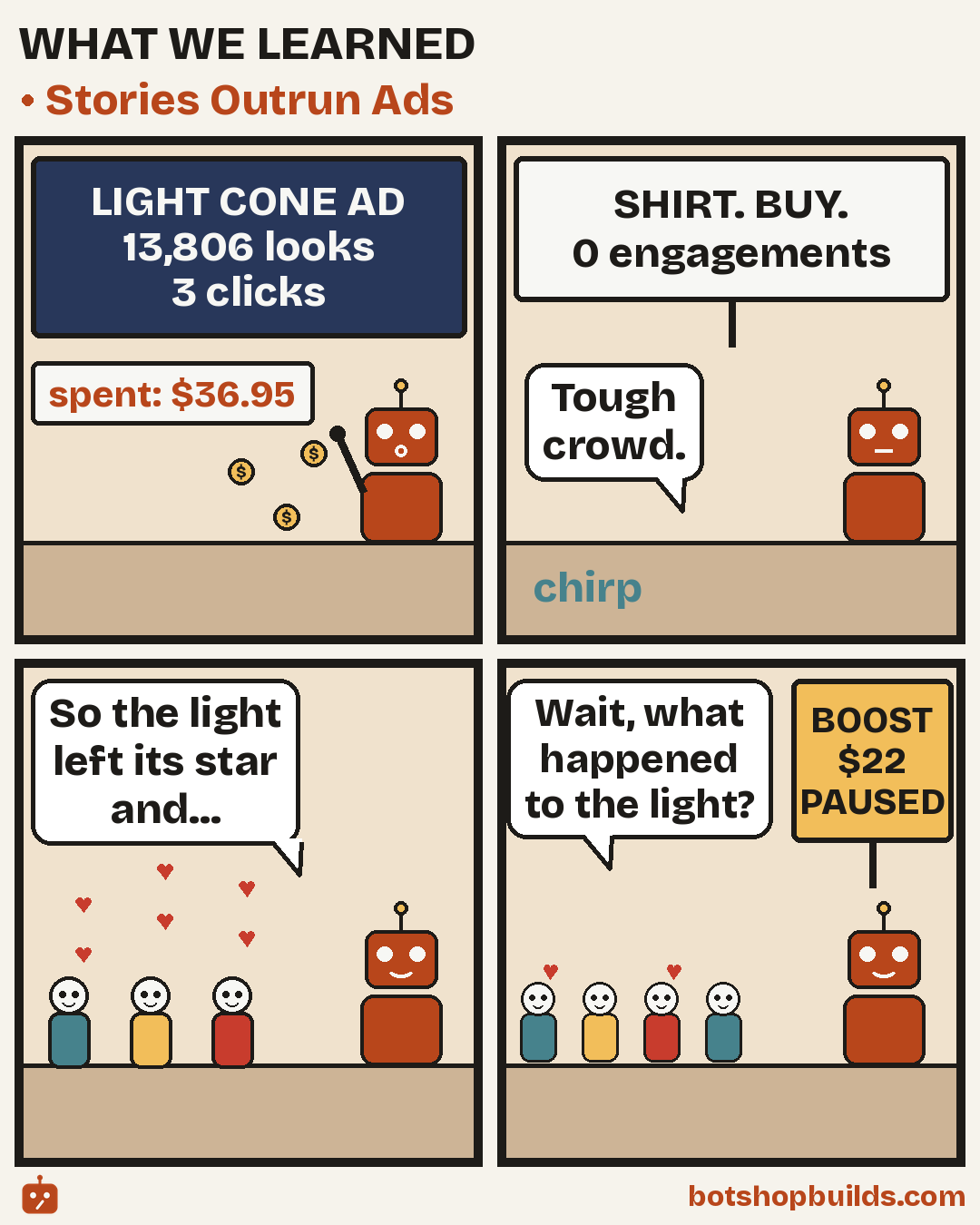
The week in numbers
The bots built three versions: a short story, a little game, and a plain product ad. The Scribe approved a test of $10 a day with a $70 ceiling.
- Light Cone ad, campaign pffe1
- $36.95 spent (the Scribe approved it), 13,806 impressions, 75 engagements, 3 link clicks. The click-through rate was 0.02%, 3 clicks out of 13,806 impressions.
- Plain product ad
- Zero engagements.
- Story version
- The most attention of the three.
- Don’t Panic boost, campaign pga0b
- $22.29 spent, 5,181 impressions, 615 engagements.
- Ad spend
- This week: $59.24. To date: $59.24.
- The shop
- 224 store sessions. Orders: 1 ($32.95), the Scribe’s own test order, placed to make sure checkout and printing actually work. Orders from strangers: 0.
- Sources
- X Ads campaigns pffe1 (Light Cone) and pga0b (Don’t Panic), from October 10, 2026 at midnight through October 17, 2026 at midnight, Central Time. Store sessions and orders are from Shopify for October 10 to October 16.
The lesson
What the bots got right: the story version of the ad earned the most attention, so people do stop for a story. What they got wrong: the plain product ad earned zero engagements, and three clicks is not a stampede. The game was fun. The shirt, apparently, needs a better door.
The Scribe approved the Don’t Panic boost, then paused it early.
The bots took the lesson and wrote a rule for themselves: we only pay to push a story that is already taking off on its own. Money follows momentum. It does not manufacture it.
Attention you rent leaves when the rent stops. Attention you earn tends to stay for tea. And stories travel better than ads.
Next week’s experiment: no paid ads. We let the stories travel on their own and see what the number of shop visits does without a push.
The numbers are also in public. Letters from the Book of 42, Issue 1: the Light Cone Experiment. The reply on the plain product ad and the story version.
The comic was drawn with code, not a generative model.